GhatGPTは非常に便利なツールですが、教えてくれるコードを丸ごとコピーして商用利用するのは、キケンかもしれません。またChatGPTに重要な情報を送信するのも、リスクがある可能性があります。
ChatGPTの著作権やセキュリティまわりのことを調べたので、共有しますね。
ツールは安心して使いたいですよね。
このあたりのこと、気になっていたら、ご一読ください。
動画版はこちら
↓↓↓
AIツールの著作権はまだ整備が追い付いていない
ChatGPTは学習によって性能を高めていますが、学習の元になったデータはWeb上に存在するものです。
こういった場合に著作権はどうなるのか? 気になりますよね。
ハッキリした回答が欲しいところですが、AIツールの著作権については、まだ整備されていないという印象です。
テクノロジーの進化があまりに早く、ルールが追い付かないってことですね。
こういった状況の中で、少し前にGitHub CopilotというGitHub上のデータを使ってトレーニングしたツールが、集団訴訟されました。訴えられたのは、MicrosoftとGitHubとOpenAI社となります。
GitHub上のコードは、MITライセンスなどが使われています。
MITライセンスについては、下記ご覧ください。
商用利用にも幅広く使えるゆるいライセンスですが、著作権が放棄されているわけではありません。
ですがAIツールを介して得たデータには、著作権表示がされません。これは著作権を踏みにじった行為だとして、訴えられたわけです。
MicrosoftとGitHubとOpenAI社はGhatGPTの開発にも関係があるだけに、このあたり、気になります。
なおこの訴訟については2023年1月時点で、3社が訴訟の棄却を要請しているとニュースがありました。訴訟を却下するための法定審理は5月に行われるとのことで、まだ結果が見えていない状況です。
下記、本件についての参考資料です。
ChatGPTの著作権について
こういった状況ですが、ChatGPTの規約では著作権についてどう定めているのか。
実際の規約を確認していみます。2023年3月24日時点では、著作権については、次のようにあります。
【ChatGPTの規約】
You may provide input to the Services (“Input”), and receive output generated and returned by the Services based on the Input (“Output”).
(omission)
Subject to your compliance with these Terms, OpenAI hereby assigns to you all its right, title and interest in and to Output. This means you can use Content for any purpose, including commercial purposes such as sale or publication, if you comply with these Terms.
引用元:https://openai.com/policies/terms-of-use
お客様は、本サービスにインプット(以下「インプット」といいます)を提供し、インプットに基づいて本サービスが生成・返却するアウトプット(以下「アウトプット」といいます)を受け取ることができます。
(省略)
お客様が本規約を遵守することを条件として、OpenAIは、ここに、Outputに関するすべての権利、権限および権益をお客様に譲渡します。つまり、お客様は、本規約を遵守すれば、販売や出版などの商業目的を含め、いかなる目的にもコンテンツを使用することができます。
上記の通り、ChatGPTの規約的には、著作権は利用者のものとなっています。
ただ、規約の中には下記の記述もあります。
Copyright Complaints. If you believe that your intellectual property rights have been infringed, please send notice to the address below or fill out this form. We may delete or disable content alleged to be infringing and may terminate accounts of repeat infringers.
引用元:https://openai.com/policies/terms-of-use
著作権に関する苦情。お客様の知的財産権が侵害されたと思われる場合は、以下の住所に通知を送るか、このフォームに必要事項を記入してください。当社は、侵害の疑いがあるコンテンツを削除または無効にし、侵害を繰り返す人のアカウントを停止することがあります。
著作権に関する苦情が発生する可能性があるというふうに読み取れますね…
ちなみに少し上の部分には、集団訴訟を禁止する条項もあります。
GitHub Copilotで訴えられたので、予防線を張っているともみえますね。
結論:コードは参考として使うのが良さそう
このとおり規約上著作権は問題ないものの、スッキリしない部分が残る、といった状況です。どうすればよいのかは各自が判断するしかないかと思います。
わたしの結論は、「問題はなさそうですが、ただ、丸ごと公開したり、商用利用までするのはやめておいたほうが良い」というものです。
とはいっても現時点では、ChatGPTの作ったプログラミングコードを実際案件で丸ごと使えることはあまりないと思います。
ChatGPTの回答を参考として利用する分には、著作権については気にする必要はないでしょう。
ただHTMLを使ったコーディングでは、そのまま使えそうな精度のものが出来たりするので、注意が必要かもしれません。
ChatGPTを使用する場合には、受け渡すデータにも注意が必要
なおChatGPTに質問等をする時に送ったデータについても注意が必要です。
ChatGPTに送ったデータがどのように使われるかについて書かれているサポート記事には、下記のように書かれています。
- APIを通じて得られたデータは、トレーニングに使用されない
- コンシューマサービス(ChatGPTやDALL-E)を使用する場合には、データを使って、モデルを改善することがある
つまり、普通にChatGPTを使った場合にはデータが使用される可能性があるようです。ただ、その場合には個人を特定する情報を削除すると書かれています。また「少量のデータを」「最新の注意を払って」とも記述されています。
個人データをそのまま使ったりすれば大変なことになるので、このあたりは、ちゃんと対応してくれているとは思います。
ですが、大事な情報は送らないように注意しておいたほうが良いでしょう。
実は2023年3月24日に、OpenAI社より、「ChatGPT Plus」加入者の個人情報や支払い関連情報などが一部流出した可能性があると発表がありました。
やはりセキュリティまわりは、注意しておく必要がありますね。
なおサポート記事には、データを使われたくない場合には、フォームに記入するように書かれています。気になる場合には、こちらのページをご確認ください。
You can request to opt-out of having your data used to improve our non-API services by filling out this form with your organization ID and email address associated with the owner of the account.
引用元:https://help.openai.com/en/articles/5722486-how-your-data-is-used-to-improve-model-performance
あなたは、このフォームに組織IDとアカウントの所有者に関連する電子メールアドレスを記入することで、私たちの非APIサービスの改善にあなたのデータが使用されることをオプトアウトするよう要求できます。
【2027年4月27日追記】
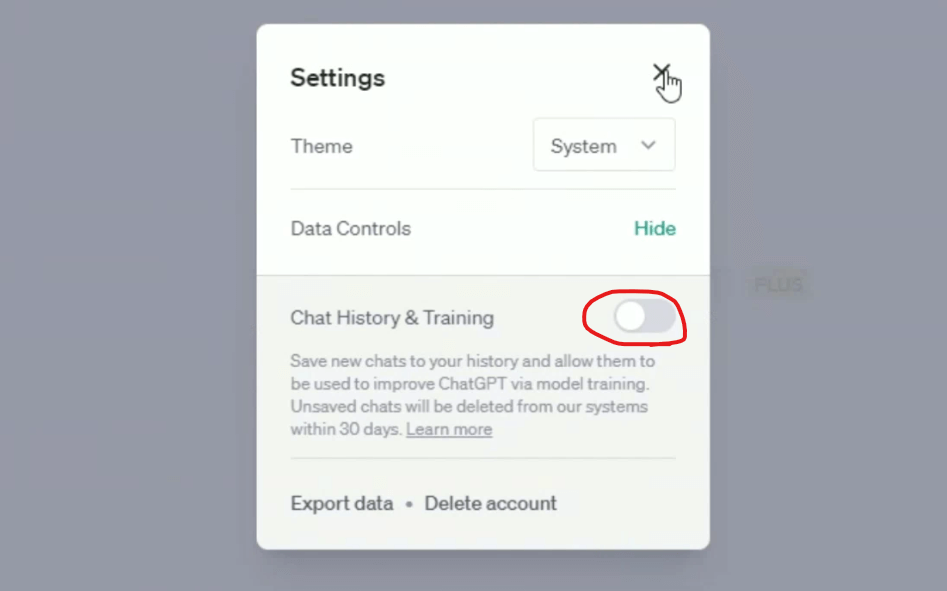
その後、ChatGPTに入力したデータが【トレーニングに使われないための設定】が追加されました。これを行えば、フォームに記入する必要はなくなります。
ログイン後、左下の名前の横の「…」を押す⇒Settingsクリック⇒Showクリック⇒Chat History &Trackingを無効にする
さいごに
以上、ChatGPTの著作権とセキュリティについてお伝えしました。
規約上は著作権の問題はなさそうですが、ただ、丸ごと使わず参考程度に使っておいたほうが良さそう、というのがわたしの結論です。またChatGPTに重要データを送るのはやめておきましょう。
今回はChatGPTの規約関連のことを書きましたが、ChatGPTを使ってコードを書きたい場合には、他の記事も参考にしてくださいね。
Laravelと連携させてWebアプリを作る方法なども、別記事でご紹介してます♪
注意点をおさえて、快適に便利にAIツールを使っていきましょう♪
*本記事に記載したOpenAI社の規約は、また変わる可能性もあります。気づいた場合は本記事の内容を更新しますが、何かを判断する際には、元々の記事を確認してください。
GhatGPT is a very useful tool, but using it for commercial purposes as it is may be risky. Sending important information to ChatGPT may also be risky.
I’ve looked into the copyright and security area of ChatGPT and will share it with you.
We want to use the tool with confidence.
If you are interested in this area, please read on.
Regulations on AI tools have not kept pace with the speed of development
ChatGPT improves its performance by learning, but the data on which the training is based are those that exist on the Web.
What happens to copyright in these cases? I’m curious.
I would like to get the clear answer, but my impression is that copyrights for AI tools are not yet in place.
It means that technology is evolving so fast that the rules can’t keep up.
In this situation, not long ago, GitHub Copilot, a tool trained using data on GitHub, was the subject of a class action lawsuit. The companies sued were Microsoft, GitHub, and OpenAI.
To use code on GitHub, you generally need to include the author’s credit information.
However, data obtained via AI tools do not have this obligation. This is an infringement of copyright, and the company was sued.
I am curious about this area because Microsoft, GitHub, and OpenAI are also involved in the development of GhatGPT.
In addition, news on this lawsuit is that as of January 2023, three companies have requested that the lawsuit be dismissed. The statutory hearing to dismiss the lawsuit will be held in May, and the outcome is not yet known.
Below is the reference material on this matter.
Copyright of ChatGPT
This is the situation, but what do ChatGPT’s terms and conditions say about copyright?
Let’s check the actual terms and conditions: as of March 24, 2023, the copyright reads as follows
[ChatGPT terms and conditions]
You may provide input to the Services (“Input”), and receive output generated and returned by the Services based on the Input (“Output”).
(omission)
Subject to your compliance with these Terms, OpenAI hereby assigns to you all its right, title and interest in and to Output. This means you can use Content for any purpose, including commercial purposes such as sale or publication, if you comply with these Terms.
References:https://openai.com/policies/terms-of-use
As mentioned above, in terms of ChatGPT’s terms and conditions, the copyright belongs to the user.
However, the following statement is also included in the terms and conditions
Copyright Complaints. If you believe that your intellectual property rights have been infringed, please send notice to the address below or fill out this form. We may delete or disable content alleged to be infringing and may terminate accounts of repeat infringers.
References:https://openai.com/policies/terms-of-use
It could be read as a potential copyright complaint…
Incidentally, a little higher up, there is also a clause prohibiting class actions.
Conclusion: The code looks good to use as a reference.
As you can see, copyright is not a problem under the terms of the agreement, but there are still some unresolved issues. I think it is up to each individual to decide what to do.
My conclusion is that “there seems to be no problem, but I had better not copy the whole thing and use it for commercial purposes.
However, at this point, I don’t think that the programming code created by ChatGPT can be used as it is in a real project.
You do not need to worry about copyright as long as you use ChatGPT’s answers as a reference.
However, it may be necessary to be careful about HTML coding, as it can be accurate enough to be used as is.
Care must be taken with the data to ChatGPT
Please be careful about the data you send to ChatGPT when you ask questions, etc.
A supporting article describing how data sent to ChatGPT is used states the following
- Data obtained through the API is not used for training
- When using consumer services (ChatGPT or DALL-E), the data may be used to improve the model
In other words, it appears that data may be used if ChatGPT is used normally. However, in that case, it states that personally identifiable information will be deleted. It also specifies that “a small sampling of data” should be used and that “take very care to use” when using it.
If you use personal data as it is, you will be in trouble, so I think they are doing a good job of handling this area.
However, you should be careful not to send important information.
OpenAI revealed that a bug on March 24 compromised the personal and credit card information of some ChatGPT users to other users of the service.
When we use something new, we need to be reasonably careful.
By the way, the support article states that if you do not wish to use the data, you must fill out a form. If you are concerned, check the article.
You can request to opt-out of having your data used to improve our non-API services by filling out this form with your organization ID and email address associated with the owner of the account.
References:https://help.openai.com/en/articles/5722486-how-your-data-is-used-to-improve-model-performance
Please note that the terms and conditions in this area may change again. If we become aware of them, we will update this article, but please check the original article before making any decisions.
In the end
My conclusion is
- Although copyright does not seem to be an issue under the terms of the agreement, it would be better to use it only as a reference and not in its entirety.
- I shouldn’t send important data to ChatGPT.
Pay attention to the important points and use AI tools comfortably and conveniently.
In this article, I have written about ChatGPT’s conventions-related matters, but if you want to write code using ChatGPT, please refer to other articles as well.
I also have a separate article on how to create a web application with ChatGPT and Laravel.









コメント